 100-night sleep trial
  100% satisfaction guarantee
  Free delivery and returns
  10-year warranty


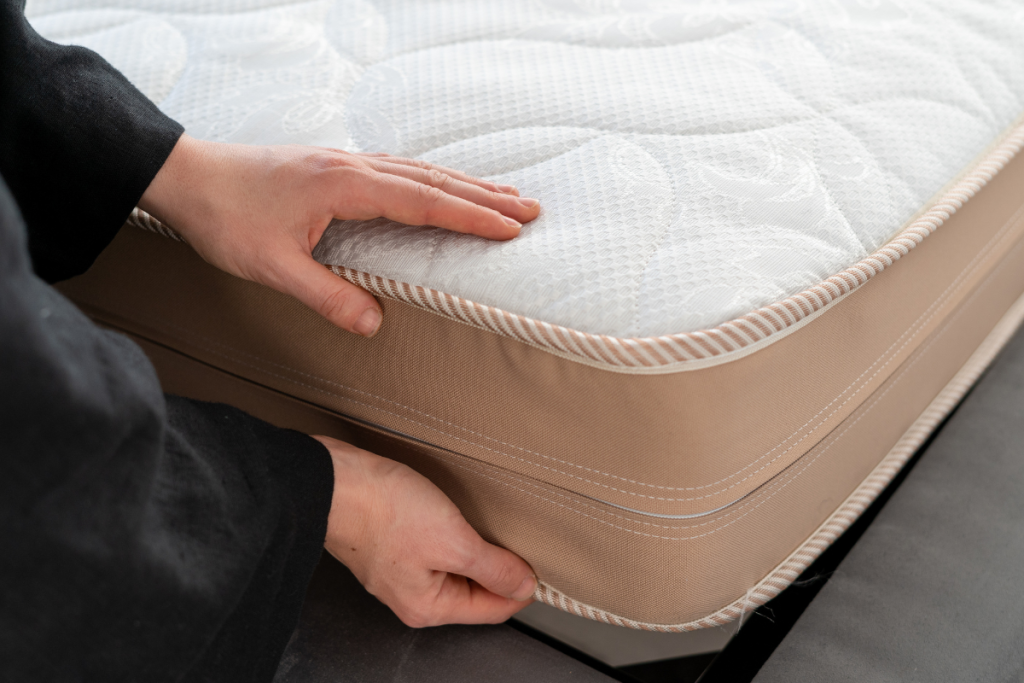

Is flipping your mattress still essential for extending its lifespan and enhancing comfort? While this was once standard advice, modern mattresses have changed the game. Whether you should flip or rotate your mattress largely depends on the type you own. In this article, we’ll explain when and how often you should flip or rotate your mattress to maximize its longevity.
-
Table of contents
- 1. Why flip your mattress?
- 2. Factors that determine how often you should rotate your mattress
- 3. Which mattresses cannot be flipped?
- 4. Need personal advice?
Why flip your mattress?
Flipping or rotating your mattress helps keep your sleeping surface hygienic and extends its lifespan. Over time, sleeping in the same spot every night creates pressure points, leading to uneven wear. Rotating or flipping helps prevent this.
There are two approaches:
- Flipping: Turning the mattress over completely (over the vertical axis) so you sleep on the opposite side.
- Rotating: Simply switching the head and foot ends of the mattress.
Flipping your mattress
If your mattress is symmetrical (the same on both sides), flipping it is preferable. This allows you to sleep on a completely fresh surface, distributing wear more evenly and giving the other side a chance to recover.
Rotating your mattress
If your mattress has a distinct comfort layer, flipping it could damage the sleep experience. In this case, rotating the mattress—switching the head and foot—without flipping is the better option. Since you’re still sleeping on the same side, it’s a good idea to do this more often than flipping.
Factors that determine how often you should rotate your mattress
How often you should rotate or flip your mattress depends on several factors:
1. Mattress material
The material plays a large role in how frequently you should rotate your mattress. Cheaper foam mattresses need to be rotated more often than higher-quality memory foam or cold foam mattresses. Always pay attention to the material composition when buying a new mattress.
- Polyfoam: Rotate/flip every 3 months
- Latex: Rotate/flip every 3 months
- Cold foam: Rotate/flip every 6 months
- Memory foam: Rotate every 6 months (flip only if there is no specific comfort layer)
- Pocket spring: Rotate every 6 months (flip only if there is no specific comfort layer)
- Hybrid: Rotate every 6 months (flipping is not recommended due to the hybrid structure)
2. Mattress usage
Mattresses used daily, such as in a master bedroom, require more maintenance than those in a guest room, which are used only occasionally.
3. Body weight and posture
The heavier the sleeper, the faster a mattress can lose its original shape. Cheaper materials, in particular, may develop sagging more quickly under heavier loads. If the sleeper has a higher body weight, it’s recommended to rotate the mattress more frequently—every 3 to 4 months—to prevent uneven wear.
4. Mattress construction
Mattresses with a symmetrical construction can be fully flipped. For mattresses with a comfort layer on one side, it’s better to rotate the head and foot ends only. This prevents wear without affecting sleep comfort.
5. Mattress quality and condition
Older and lower-quality mattresses wear out more quickly. For these mattresses, it’s wise to rotate them more often (every 3 months) to minimize sagging. Higher-quality mattresses may only need to be rotated every 6 months.
6. Sleeping position and habits
If you always sleep in the same spot and position, certain parts of the mattress will experience more pressure. Regular rotation helps distribute the load and keeps the mattress comfortable for longer.
Tip: Regular maintenance is also key to your mattress’s lifespan. In addition to flipping or rotating, make sure to clean your mattress regularly. During sleep, you lose moisture, and bacteria can accumulate in the mattress cover, affecting both hygiene and quality.
Which mattresses cannot be flipped?
Not all mattresses are designed to be rotated, and the construction plays a key role in this. Mattresses with a comfort layer on top, such as many memory foam or hybrid models, often shouldn’t be flipped, as it would negatively impact sleep comfort.
Additionally, there are now innovative mattresses that use adjustable support technologies. These are tailored to the individual sleeper, automatically distributing pressure, making manual flipping or rotating unnecessary.
This new generation of mattresses is making the traditional practice of flipping or rotating less relevant.
Need personal advice?
If you have questions about your mattress or think it’s time for a new one, the Morningstar Sleeps team is here to help. Visit our site for expert advice or try our highly-rated Morningstar Stellar mattress. With its high-density foam layers, it resists sagging, and you can try it for 100 nights risk-free!
For even greater durability, you can always use a mattress topper. Our Aero topper adds a soft comfort layer to your mattress and provides extra protection. However, a topper is not a solution for a worn-out mattress. If your mattress has deep impressions, these will quickly transfer to the topper. Flipping the topper regularly can also help extend its lifespan.

